



“Wait a minute, Kathy!” some of you may be saying. “My kids go to school all week long. The last thing they will want to talk about is nouns and verbs in Sunday school!”
But I say, “Oh, yes they will!” A good friend of mine taught me a simple method that works for both visual and oral learners: in a Bible story, the nouns become your props — the things kids can see or touch — and the verbs become your message links, the actions you use to point kids toward spiritual application.
🎉 Want FREE Bible Games for Your Kids?
Grab 6 free Bible resources instantly — perfect for Sunday Schools, homeschools, and Christian Classrooms!
YES, PLEASE! →🔒 No spam, ever. Unsubscribe anytime.
This Bible storytelling idea will help you bring any Bible story to life for kids ages 4-10, and for this one you will need the following:
- A Bible, or a printed/photocopied passage you can mark up freely
- A simple prop for each noun you plan to highlight — nothing fancy
How it works:
- Pick a passage or Bible story to share — a short gospel story or New Testament passage works well. Give yourself 10–15 minutes for preschoolers, or 15–25 minutes for older elementary kids.
- If you don’t want to mark up your own Bible, print or photocopy the passage so you’re free to write on it.
- Circle the nouns in the passage — these become your props (a loaf of bread, a basket, a blanket). For ages 4–6, choose just 1–2 strong nouns. For ages 7–10, highlight several and invite the kids to help you find them.
- Underline the verbs — these become your message links. Pick one or two to focus on as your life application for the day (for example, “thank,” “give,” “wait,” or “listen”).
Here’s how it comes together: for “The Feeding of the 5,000” (Matthew 14:13-21 or John 6:1-15), the main nouns are bread, fish, a boy’s lunch, baskets, and a big crowd of people. Bring an easy prop for each — a small loaf, a tin of fish (or a substitute), a basket.
Then choose your verbs. In this story, I like to focus on three: Jesus asked the people to sit (teaching patience and listening), Jesus thanked God for the food (modeling thanksgiving), and Jesus gave the bread away (teaching generosity and sharing). These verbs become short, memorable lessons kids can carry with them all week.
Try these quick prompts during your lesson:
- For “asked” — ask, “When does God ask you to wait?” (pause for answers)
- For “thanked” — model a 15-second prayer of thanksgiving, then invite each child to name one thing they’re thankful for
- For “gave” — suggest a small classroom kindness, like sharing a sticker or a prayer card, to practice generosity
Ages 4–6 respond best to one clear verb and a dramatic prop — act it out together! Ages 7–10 can help identify the nouns and verbs themselves, act out short scenes, and answer a couple of guided questions. For oral learners and kinesthetic kids, invite them to pass the props around, act out the actions, or retell one sentence of the story in their own words.
Suggestions for Success:
- Create or print a simple “noun and verb” worksheet for your group to reinforce the lesson.
- Invite a parent or volunteer to practice this method with you — it builds everyone’s confidence in telling Bible stories.
- Reuse this method with a brand-new passage each week; it works with almost any Bible story.
🎉 Want FREE Bible Games for Your Kids?
Grab 6 free Bible resources instantly — perfect for Sunday Schools, homeschools, and Christian Classrooms!
YES, PLEASE! →🔒 No spam, ever. Unsubscribe anytime.
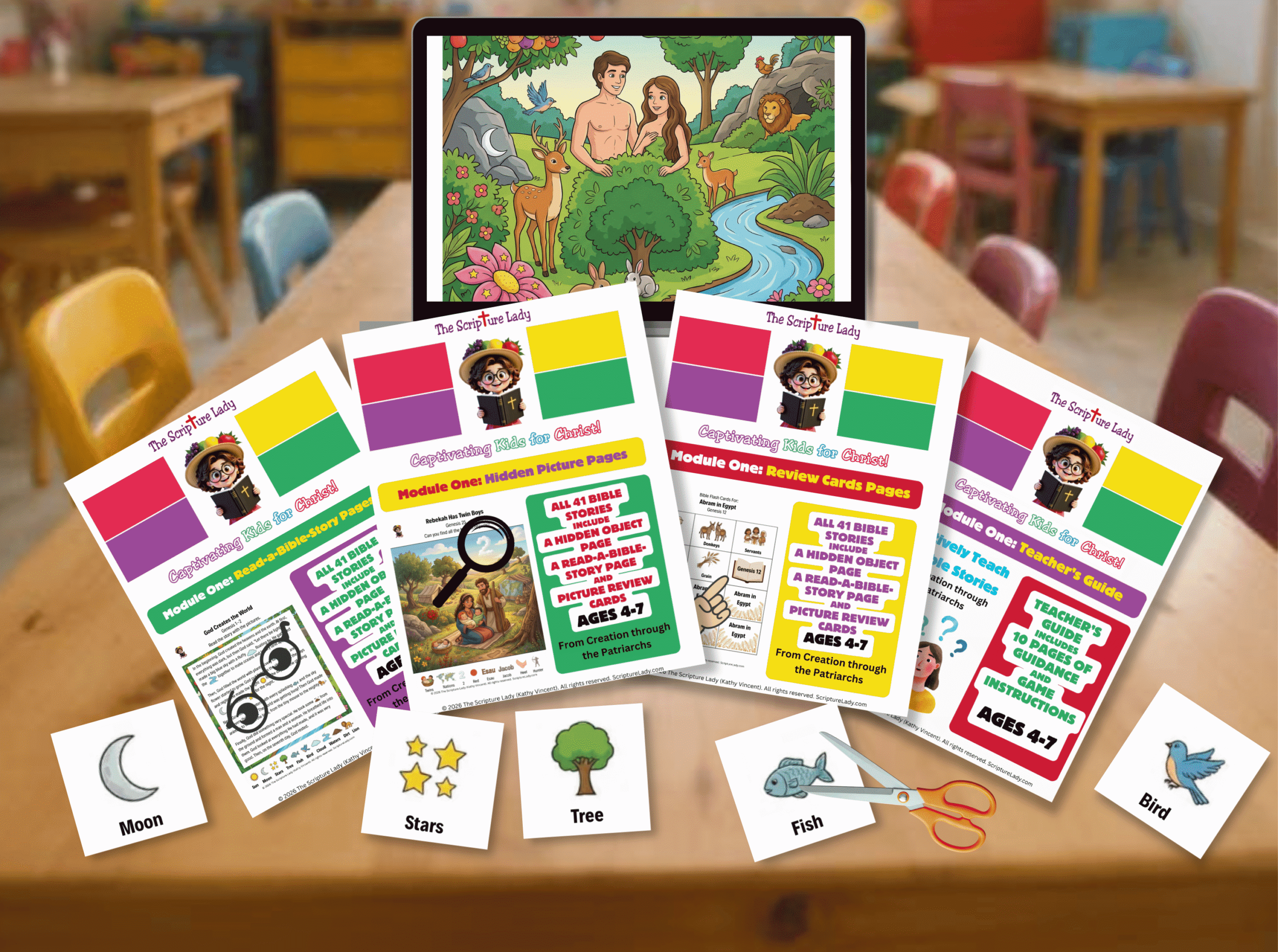
Want to Make Bible Time Truly Unforgettable?



Focusing on the nouns and verbs of a story has helped me shape clearer, more memorable bible storytelling sessions — and I hope it helps you too.
Kathy, let me know if you have any workshops scheduled that I can join in on. I work with 1st- 6th grade teaching a Bible Study and Bible Club.